How to Do the Barbell Back Squat
The barbell back squat is the foundational lower-body strength lift, training the quads, glutes, and hamstrings through a deep, loaded knee and hip bend.
Safety review: Awaiting named reviewer before approval. Editorial technique and programming guidance, not medical advice. Use qualified coaching or clinical care for pain, injury history, or movement-specific restrictions.
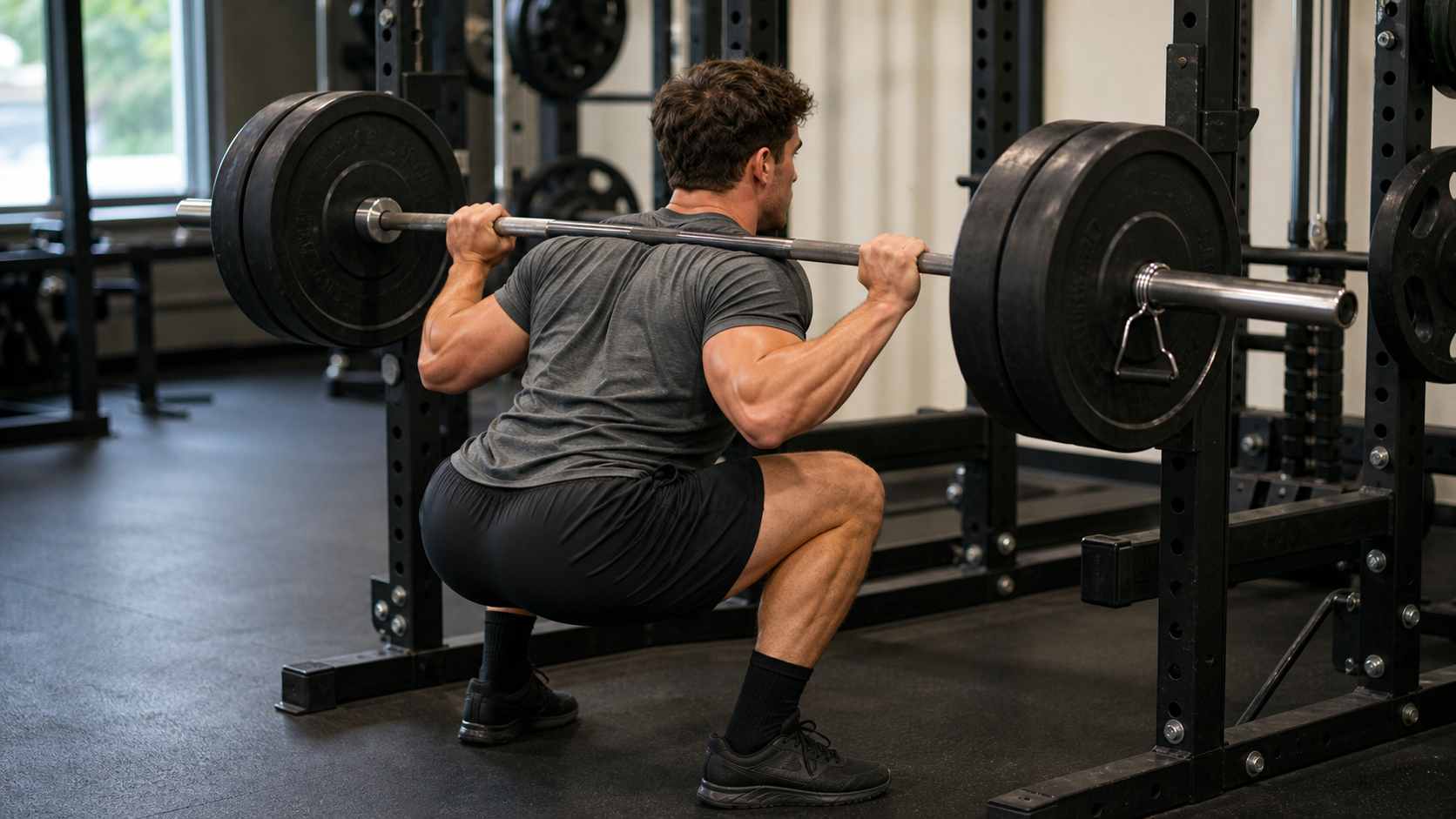
Primary muscles
Quads, Glutes
Secondary muscles
Hamstrings, Core, Lower back
Equipment
Barbell
Level
Intermediate
Type
Compound
Typical reps
3-8 for strength practice, 6-12 for muscle-focused sets
The barbell back squat is the lift most strength programs are built around, and for good reason. Loading a deep knee and hip bend across the upper back trains the quads and glutes hard while demanding full-body bracing, which is why it carries over to almost everything else you do in the gym.
It is also a lift where form and depth matter more than ego weight. A controlled squat through a range you can own is more useful than a heavier quarter-rep. Depth should be consistent, braced, and pain-free rather than forced.
Direct answer: how to squat with a barbell
Set the bar securely across your upper back, brace your trunk, take a stable stance, and squat down by bending knees and hips together. Keep the whole foot planted, let the knees track in the same direction as the toes, and stand back up without losing your brace.
Most good squat reps have these traits:
- Bar starts over the middle of the foot.
- Brace is set before the descent.
- Knees track over the toes instead of collapsing inward.
- Depth is repeatable from rep to rep.
- Hips and chest rise together out of the bottom.
If the bar shifts forward, your heels lift, or your lower back rounds hard at the bottom, reduce load and fix the position first.
Technique sources: The setup cues above are based on coaching references from Stronger by Science, Barbell Medicine, and the NSCA high-bar squat technique video. The exact stance and bar position still need to fit the lifter.
Common squat mistakes and fixes
| Mistake | What it looks like | Likely cause | Fix |
|---|---|---|---|
| Knees cave in | Knees drift inward as you stand | Load too heavy, weak position, or poor foot pressure | Reduce load and cue knees in line with toes |
| Heels lift | Weight shifts toward the toes | Stance, ankle mobility, or balance issue | Keep the whole foot planted and slow the descent |
| Depth changes | Early reps are deep, later reps become high | Fatigue or load too heavy | Count only repeatable reps and stop the set sooner |
| Lower back rounds hard | Pelvis tucks and brace disappears near the bottom | Depth beyond current control or weak brace | Use a pain-free depth and rebuild bracing |
| Chest shoots up late | Hips rise first and bar drifts forward | Poor brace or bar path | Pause lighter reps and keep hips and chest rising together |
Muscles worked
The back squat is a compound lower-body lift. The quads and glutes do most of the visible work, while the hamstrings, trunk, and lower back help control the bar and keep the torso stable.
| Muscle group | Role in the squat |
|---|---|
| Quads | Extend the knees as you stand up |
| Glutes | Extend the hips out of the bottom |
| Hamstrings | Assist hip control and stabilize the lower body |
| Core and lower back | Brace the trunk so the bar stays controlled |
Muscle sources: ExRx’s barbell squat entries list the quadriceps and glute contribution, while the squat biomechanics review gives broader context on how stance, depth, and bar position change loading.
High-bar vs low-bar squat
| Variation | Best for | Main tradeoff |
|---|---|---|
| High-bar back squat | General strength, quads, Olympic-style lifting, simpler upright position | Usually less total load than low-bar |
| Low-bar back squat | Powerlifting and moving heavier loads | More hip hinge, shoulder demand, and setup precision |
| Paused squat | Position strength and control | Uses lighter loads and feels harder |
| Tempo squat | Learning balance and bracing | More fatigue per rep |
Neither bar position is automatically best. Pick the one you can perform consistently, pain-free, and with the goal you care about.
Bar-position source: Stronger by Science’s high-bar vs low-bar squat guide is the main source for this tradeoff. This page treats high-bar and low-bar as useful variations, not as universally better or worse choices.
Setup checklist
| Setup point | What to do | Why it matters |
|---|---|---|
| Rack height | Set the hooks around upper-chest height | Lets you unrack without a calf raise or half squat |
| Bar position | Place the bar on upper traps for high-bar or rear delts for low-bar | Controls torso angle and loading style |
| Stance | Start around shoulder width with toes slightly out | Gives the hips and knees room to move |
| Brace | Big breath into the trunk before every rep | Keeps the torso rigid under load |
| Walkout | Use one or two steps back, then settle | Saves energy and improves repeatability |
Do not rush the walkout. A messy setup usually turns into a messy rep.
Programming examples
| Goal | Sets and reps | Notes |
|---|---|---|
| Beginner practice | 2 to 3 sets of 5 to 8 | Start light and make depth consistent |
| Strength | 3 to 5 sets of 3 to 6 | Use longer rests and stop before form breaks |
| Hypertrophy | 3 to 4 sets of 6 to 12 | Use controlled reps and a repeatable depth |
| Technique block | 3 to 5 sets of 3 to 5 paused reps | Useful when the bottom position is unstable |
Most lifters should squat one to three times per week depending on program, recovery, and how heavy the work is. Add weight only when the previous sets hit depth with a stable brace.
Programming note: These are Brace AI editorial starting examples, not universal rules. They are consistent with general resistance-training progression guidance from the ACSM progression model, but your exact squat frequency, load, and reps should come from the full program, recovery, and technical consistency.
How to progress the squat
Progress the squat only when the reps still look like the reps you want to keep training.
| Situation | Next step |
|---|---|
| All sets hit depth with a stable brace | Add a small amount of weight next time |
| Last reps grind but form stays consistent | Repeat the same load before adding more |
| Depth shortens or knees cave late in the set | Keep the load or reduce reps |
| Pain changes your movement | Stop the set and switch to a pain-free variation |
| You miss the same target for two or three sessions | Reduce load, lower volume, or use a simpler variation |
The goal is not to add weight at any cost. The goal is to add load while keeping depth, bracing, and bar control honest.
Alternatives and regressions
| Alternative | Best for | Tradeoff |
|---|---|---|
| Goblet squat | Learning depth and balance | Hard to load heavy long term |
| Front squat | Upright torso and quad emphasis | More wrist, upper-back, and mobility demand |
| Box squat | Depth target and control | Can become a different lift if you relax on the box |
| Leg press | High quad volume with less balance demand | Less trunk and free-weight skill |
| Split squat | Single-leg strength and mobility | More balance and local fatigue |
Use these when the barbell back squat is not the best current tool. A variation that you can train well beats a main lift you cannot load or recover from.
Safety and troubleshooting
Knee cave, heel lift, and lower-back rounding are usually signals to adjust stance, load, depth, or bracing. They are not moral failures; they are feedback.
Stop a set if pain changes your movement, if the bar path shifts dramatically, or if you cannot keep the torso braced. For injury history, sharp pain, or persistent symptoms, use a qualified coach or clinician instead of forcing online cues onto your body.
Safety source: This section stays conservative on purpose. The NSCA squat technique reference, squat biomechanics review, and clinical-practice squat review support focusing on controlled movement, appropriate variation choice, and professional help for pain or injury history.
How we evaluated this guide
We checked squat recommendations against coaching sources, exercise technique references, high-bar vs low-bar analysis, exercise-library muscle references, and biomechanics material. The guide prioritizes repeatable setup, pain-free depth, and controlled progression because those are the pieces that make squat training useful across many body types and goals.
The practical answer
Short answer
Use the barbell back squat when you want a compound lift that trains quads, glutes with clear progressive overload. It is most useful when you can keep the setup repeatable, move through a controlled range of motion, and add load or reps without changing the form.
The lift belongs in a program, not as a random challenge. Start with a load you can control, keep a few clean reps in reserve, and progress only when the working sets look the same from first rep to last rep.
Claim-source map
How we picked and source-checked this exercise guide
We separate sourced exercise facts from editorial coaching judgment so the guide is easier to verify, update, and cite.
Setup and technique
The setup checklist, step-by-step cues, bar path, and range-of-motion guidance are practical cues based on the technique references.
- Stronger by Science: how to squat (strongerbyscience.com/how-to-squat) - Used for squat setup, stance, bracing, and depth context.
- Stronger by Science: high-bar and low-bar squatting (strongerbyscience.com/high-bar-and-low-bar-squatting-2-0) - Used for bar-position differences and tradeoffs.
- Barbell Medicine: how to squat (barbellmedicine.com/blog/how-to-squat) - Used for practical setup and coaching cues.
Muscles worked
Primary and secondary muscle claims come from exercise-library and biomechanics sources, then are translated into plain English.
- ExRx: barbell squat (exrx.net/WeightExercises/Quadriceps/BBSquat) - Used for muscles worked and movement classification.
- PMC: squat biomechanics review (pmc.ncbi.nlm.nih.gov/articles/PMC10987311) - Used for biomechanics, squat variation, and loading context.
- NSCA: high-bar back squat technique (nsca.com/education/videos/exercise-technique-high-bar-back-squat) - Used for exercise-technique standards.
Sets, reps, and progression
Programming ranges are coaching defaults. Use them as starting points, then adjust load, volume, and frequency based on recovery and rep quality.
- ACSM resistance training progression model (pubmed.ncbi.nlm.nih.gov/19204579/) - Used for general resistance-training progression, loading, and frequency context.
- NSCA: high-bar back squat technique (nsca.com/education/videos/exercise-technique-high-bar-back-squat) - Used for exercise-technique standards.
- PMC: squat biomechanics review (pmc.ncbi.nlm.nih.gov/articles/PMC10987311) - Used for biomechanics, squat variation, and loading context.
Safety and troubleshooting
Pain, regression, and mistake guidance is editorial coaching support, not diagnosis or medical advice.
- PMC: squat implications for clinical practice (pmc.ncbi.nlm.nih.gov/articles/PMC4262933) - Used for conservative safety and movement-variation context.
- NSCA: high-bar back squat technique (nsca.com/education/videos/exercise-technique-high-bar-back-squat) - Used for exercise-technique standards.
Fit check
Who this is for
This section is meant to help you decide whether the exercise belongs in your program, not just whether you can perform it once. A good fit means the movement matches your goal, equipment, current skill level, and ability to progress it without losing form.
Best fit
Lifters who want to build quads, glutes with a movement that can be tracked and progressed over time.
Not ideal if
You cannot set up the movement consistently yet, feel joint pain during warm-ups, or need a simpler variation to learn the pattern first.
How to progress
Add reps first, then small weight jumps once every set stays controlled. If form changes, hold the load and earn cleaner reps before increasing again.
Technique
How to Do the Barbell Back Squat
- 01
Set the bar in the rack at upper-chest height. Step under it and rest it across your upper traps, not your neck.
- 02
Grip the bar evenly, brace your core, lift it off the rack, and take one or two steps back into a stance about shoulder-width apart.
- 03
Take a big breath, brace, and sit down and back, letting your knees track over your toes.
- 04
Descend until your hip crease drops below the top of your knee, keeping your chest up and heels flat.
- 05
Drive through the whole foot to stand back up, exhaling near the top. Reset your breath and brace for the next rep.
Programming
How to program the Barbell Back Squat
Most lifters should treat the barbell back squat as a main movement or a serious accessory, depending on their goal and recovery. Use the lower end of the rep range when strength is the priority and the higher end when you want more practice, muscle-building volume, or a slightly easier recovery cost.
A simple progression is to keep the same weight until all working sets reach the top of the rep range with clean technique, then add the smallest practical jump next time. This keeps progressive overload tied to execution rather than ego.
Troubleshooting
Common barbell back squat mistakes
- Letting the knees cave inward under load instead of tracking over the toes.
- Cutting depth short and calling it a rep. Aim for at least parallel.
- Rounding the lower back at the bottom because the brace was lost.
- Rising onto the toes and shifting weight forward out of the hole.
Coach cues
Form tips to get more from it
- Brace as if bracing for a punch before every rep, not just the first.
- Point your toes out slightly to make room for your hips.
- Film a set from the side to check real depth instead of guessing.
- Add weight only when every rep hits depth with clean form.
References
Sources and freshness
Sources were reviewed on June 8, 2026. Squat technique depends on limb length, mobility, bar position, goal, and injury history, so this page avoids one-size-fits-all rules. Use pain-free depth, controlled reps, and professional guidance if squatting causes sharp or persistent pain. The hero image is a self-hosted editorial training visual created for this guide, not a source for technique claims.
Sources
- 01 Stronger by Science: how to squat (Used for squat setup, stance, bracing, and depth context.) strongerbyscience.com/how-to-squat
- 02 Stronger by Science: high-bar and low-bar squatting (Used for bar-position differences and tradeoffs.) strongerbyscience.com/high-bar-and-low-bar-squatting-2-0
- 03 Barbell Medicine: how to squat (Used for practical setup and coaching cues.) barbellmedicine.com/blog/how-to-squat
- 04 NSCA: high-bar back squat technique (Used for exercise-technique standards.) nsca.com/education/videos/exercise-technique-high-bar-back-squat
- 05 ExRx: barbell squat (Used for muscles worked and movement classification.) exrx.net/WeightExercises/Quadriceps/BBSquat
- 06 PMC: squat biomechanics review (Used for biomechanics, squat variation, and loading context.) pmc.ncbi.nlm.nih.gov/articles/PMC10987311
- 07 PMC: squat implications for clinical practice (Used for conservative safety and movement-variation context.) pmc.ncbi.nlm.nih.gov/articles/PMC4262933
- 08 ACSM resistance training progression model (Used for general resistance-training progression, loading, and frequency context.) pubmed.ncbi.nlm.nih.gov/19204579/