Apple Watch in development / Interface preview
Apple Watch
Apple Watch workout logging for lifters
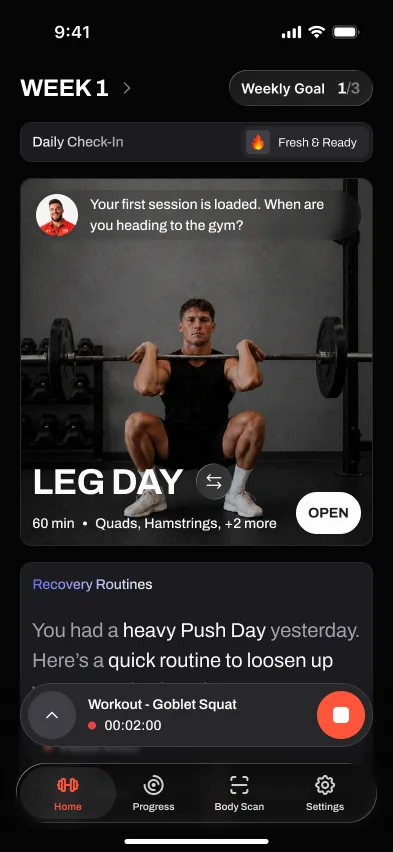
Brace AI is iPhone-first with Apple Watch as the workout-floor companion for wrist-friendly set entry and rest timers.
Short answer
Reviewed June 2026
Between sets is the worst time to wrestle with a phone. Brace AI is iPhone-first, and the Apple Watch workflow keeps quick logging and rest timers closer to the lifter during a session.
We judge the workflow by what happens during real training: starting the session, logging cleanly, keeping momentum between sets, and turning workout history into a useful next step. Product screens shown here come from private testing and do not represent a public store release.
The workflow
Watch workout workflow
- 01
Start the session
Open the workout on phone first, then keep the intended session flow close while you train.
- 02
Log with fewer taps
Confirm common set actions from the wrist without digging through a phone between sets.
- 03
Rest timer support
Rest timing belongs in the workout flow because lifters need it mid-session.
- 04
Sync back to phone
Watch entries feed the same history that powers coaching and progression.
Why it matters
Why wrist logging is better
Faster between sets
Use quick wrist actions for common logging moments instead of unlocking a phone every set.
Rest timers with haptics
Rest reminders are one of the main reasons watch support matters for strength training.
Effort context
Heart-rate and effort context can help explain how hard the session was once the watch flow is live.
Synced workflow
The goal is one workout history across phone and watch, not a separate wrist log.
Workflow comparison
Wrist versus phone at the rack
Phones are fine for planning. Mid-session, they slow you down and break focus.
Doing it manually
- Unlock, open the app, find your set
- Tap a separate timer app for rest
- Phone on the floor between sets
- No effort data unless you wear a strap
Brace AI test build
- Quick set confirmation on the wrist
- Rest timer prompts
- Phone-first planning with watch support during the session
- Health and effort context in one training history when available
Where it helps
Before, during, and after training
The point is not to add another screen to manage. The feature should make the workout easier to start, faster to log, and clearer to review once the session is over.
Before training, it should remove uncertainty about what to do or which load to use. During the workout, it should stay quiet and fast enough for real rest periods. Afterward, it should turn the session into a useful next action instead of leaving the history to interpret manually.
The practical test is whether the feature still saves time, clarifies decisions, or prevents missed data after ten sessions. If it only looks impressive in onboarding, it is decoration.
Evaluation standard
Reviewed around real gym use
Platform support, watch behavior, offline sync, and pricing should be rechecked from first-party pages at publish time. Private-test behavior may change before release.
Workout-floor speed
Logging, checking targets, and moving to the next set should get faster, not create a second screen to manage.
Progression clarity
The feature should explain the next action: add load, hold steady, swap an exercise, rest longer, or adjust the week.
Reliability
Phone, watch, offline, and sync behavior need to hold up under short rest periods and weak gym signal.
Frequently asked questions
Is Brace AI built for Apple Watch users?
Will the watch app track heart rate?
Will rest timers buzz my wrist?
Does it work with other watches?
Private iOS testing · Apple Watch in development
Train with a coach, not a logbook.
Brace AI builds the plan, tracks the workout, and explains the next training decision without turning your gym session into spreadsheet work.